Sponsored by Booking.com
Last updated: May 28, 2026
Most travellers who ask us about the Cyclades head straight to Santorini, Mykonos, or even Naxos and Paros. But when we want to share a secret, we talk about the northern trio: Syros, Tinos, and Andros. These three islands sit in the upper arc of the Cyclades, are served by fast ferries from the mainland, and share almost none of the mass-tourist infrastructure that crowds the southern islands every July and August.
What they do share is genuine Greek life, working ports, village kafeneions where locals actually eat, hiking trails that feel genuinely wild, and architecture that tells the layered story of Venetian, Cycladic, and neoclassical Greece. If you're choosing between them for 2026, this guide will help you decide.
→ Syros travel guide | Tinos travel guide | Andros travel guide
The Quick Answer
| What You Want | Best Island |
|---|---|
| Neoclassical capital and urban culture | Syros (Ermoupoli) |
| Best beaches and coves | Andros |
| Hiking and nature trails | Andros |
| Food scene and gastronomy | Tinos |
| Religious pilgrimage and marble craft | Tinos |
| Families with young children | Andros (calm, shallow bays) |
| Closest ferry from Athens (Rafina) | Andros |
| Year-round island life | Syros |
Syros, The Capital Island
Syros is unlike any other Cycladic island because it never lost its soul to tourism. As the administrative capital of the entire Cyclades archipelago, it has always had a reason to exist beyond summer visitors: law courts, hospitals, banks, the port authority, and a year-round population of around 21,000 people.
Ermoupoli: The Grandest Town in the Cyclades
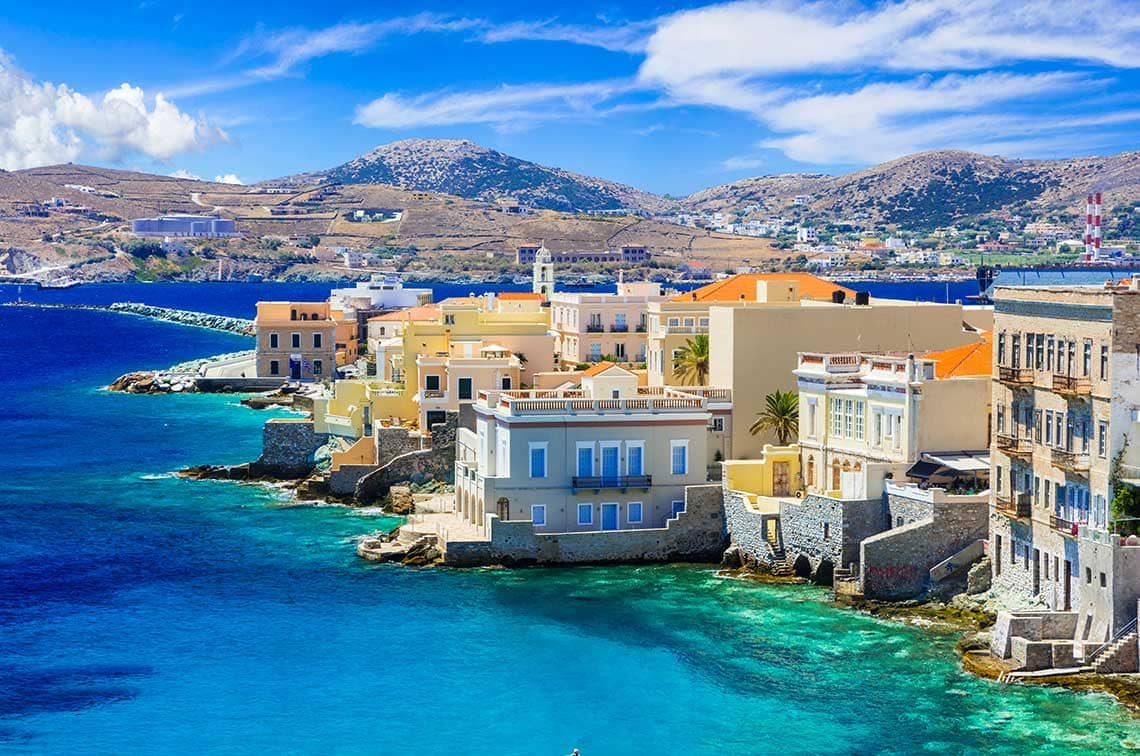
Walk off the ferry and Ermoupoli will genuinely surprise you. Instead of the whitewashed cubic geometry you expect from the Cyclades, you're confronted with a sweeping neoclassical cityscape, marble-paved Miaouli Square flanked by a grand town hall, neoclassical mansions painted in ochre and pale blue, a 19th-century opera house (the Apollo Theatre, a scaled-down replica of La Scala), and a working industrial waterfront. This was once the most important port in the eastern Mediterranean, and the bones of that ambition are still everywhere.
Climb the twin hills above the port for two very different perspectives. Ano Syros, the Catholic hill quarter, is a medieval settlement of whitewashed lanes, Venetian-influenced chapels, and panoramic views. Vrodado, the Orthodox hill, is crowned by the Church of the Anastasis. The sight of both hilltop churches looking down at each other is one of the most quietly symbolic views in Greece.
Culture, Food, and Off-Season Appeal
Syros works beautifully outside peak summer. Cafés and restaurants stay open year-round, there's a small but excellent archaeological museum, and the island hosts cultural events, including a local carnival that rivals Patras for atmosphere. For food, don't leave without trying loukoumi (a soft rose-water confection sometimes called Greek Turkish delight), which has been made on Syros since the 19th century.
Find hotels on Syros for prices and availability, the island has a good spread from boutique guesthouses in the old town to beachside apartments on the quieter south coast.
Tinos, Villages, Marble, and the Best Food in the Cyclades
Tinos is famous across Greece for two very different things: the Panagia Evangelistria, one of the most sacred churches in Orthodox Christianity, and a culinary reputation that has made it a destination for serious food travellers from across Europe.
Pilgrimage and the Church of Panagia Evangelistria
Every year on August 15th, the Feast of the Dormition of the Virgin, thousands of pilgrims travel to Tinos to crawl on their knees up the main street from the port to the church. The icon of the Virgin Mary housed inside is considered one of the most miraculous in Greece, and the church is draped in gold and silver offerings from grateful worshippers. Even if you're not religious, witnessing this devotion, and the quiet everyday faith of the islanders, is genuinely moving.
Marble Villages and the Craft of Stone
Tinos is the home island of Greek sculptor Giannoulis Chalepas, and the tradition of marble carving runs deep. The village of Pyrgos, in the island's north, is a working centre of marble craft: you'll find family workshops where craftsmen still cut decorative lintels, gravestones, and sculptures by hand. The local school of fine arts trained many of modern Greece's most important sculptors. Walking through Pyrgos and the surrounding villages, Volax, with its extraordinary landscape of rounded granite boulders, is unmissable, feels like stepping into a living museum that no one is curating for your benefit.
Tinos Food Culture
Tinos has quietly become one of the most talked-about food destinations in Greece. Local products drive the conversation: the island's artichokes are prized across the country, its fresh cheeses (especially the soft, creamy kopanisti) are outstanding, and its loukoumades (honey doughnuts) are legendary. A new wave of chefs has opened restaurants in Tinos Town and the villages that cook with these ingredients seriously, without pretension. It's the kind of food scene that deserves to be far more famous than it's.
Explore where to stay on Tinos, accommodation fills up around August 15th, so book well ahead for the pilgrimage season.
Andros, Hiking, Sailing, and the Greenest Island
Andros is the northernmost island in the Cyclades and, by some distance, the greenest. Streams run year-round through its valleys, dovecotes (ancient pigeon towers unique to the island) dot the hillsides, and the interior is laced with a marked network of hiking trails that make it the most walkable island in the archipelago.
Hiking the Andros Route Network
The island's trail network is extraordinary by Greek standards. The main Andros Route (a 110 km waymarked trail) traverses the island from north to south, passing through mountain villages, over stone-arched bridges, and alongside rushing streams shaded by plane trees. Day sections are easily accessible, the walk from Apikia to Stenies along the river valley is one of the most beautiful short hikes in the Cyclades. The trail infrastructure is well-maintained, with clear signage and up-to-date maps available from the local hiking association.
Beaches and Sailing
Andros also punches well above its weight on beaches. Agios Petros is a long sandy bay with shallow water ideal for families. Achla is a large, undeveloped beach backed by a stream that requires a 45-minute hike through a gorge, the effort keeps the crowds away. Vitali is a favourite with sailors, and Andros Town (Chora) has a scenic beach just below the medieval Venetian castle. The island's position at the top of the Cyclades makes it a natural first or last stop on a sailing itinerary down the archipelago.
Andros Town (Chora)
Unlike Ermoupoli's neoclassical grandeur, Andros Chora is deeply Cycladic in character, a narrow promontory town of white cubes, arched passages, and marble-paved streets jutting into the sea. Its Museum of Modern Art houses a remarkable permanent collection including works by internationally significant Greek artists. It's a quietly cultured town that most Cyclades visitors never see.
Book accommodation on Andros, the island is popular with Athenian families in August, so July or September gives you more breathing room.
Getting There from Athens
All three islands are served by ferry from the Greek mainland, but the port and journey times differ.
Andros is the easiest and fastest to reach. Ferries depart from Rafina (Athens' eastern port, about 45 minutes from the city centre by bus or taxi) and reach Andros in approximately 2 hours. This makes Andros an accessible long-weekend destination even in late spring or early autumn. Check direct ferry routes from Athens to Syros for current schedules and operators.
Tinos is served by both Rafina and Piraeus with journey times of roughly 3 to 4 hours depending on the route. High-speed catamarans cut that to around 2.5 hours from Piraeus. See ferry routes from Athens to Tinos for up-to-date options.
Syros can be reached from Piraeus in approximately 4 to 4.5 hours on a conventional ferry, or around 2.5 hours on a high-speed service. The Piraeus departure is generally most convenient for travellers staying in central Athens.
One useful feature of this cluster: once on any of the three islands, short inter-island ferries connect them frequently in summer, making it easy to combine two or even all three on a single trip.
Which Should You Choose?
Here's our honest summary after years of recommending all three islands:
Choose Syros if you want an actual city experience on a Greek island, grand architecture, good restaurants year-round, museums, and the curious pleasure of watching a real urban community go about its life beside the Aegean. It's also the right choice for travellers who want to visit outside peak summer.
Choose Tinos if food and authentic village culture are your priorities, if you want to witness one of the most extraordinary religious events in Greece, or if you're drawn to the unusual, marble-carvers in mountain workshops, a boulder-strewn lunar landscape at Volax, some of the best local cheese in the country.
Choose Andros if you want to walk, swim, and sail with very few other tourists around. It offers the best beaches of the three, the most developed trail network, and a pace that rewards slow travel. It's also the easiest to combine with a long weekend from Athens.
If you've 10 days and can island-hop, combining all three is entirely feasible and deeply rewarding. For more ideas on under-the-radar Cyclades choices, see our guide to quiet Greek islands.
Frequently Asked Questions
Which is the best of Syros, Tinos, and Andros?
It depends on your priorities. Syros is best for culture and year-round island life. Tinos is best for food and pilgrimage. Andros is best for hiking and beaches. All three offer a genuinely authentic Cyclades experience far removed from the mass-tourist circuit.
Which is easiest to reach from Athens?
Andros, by a clear margin. The Rafina–Andros ferry takes around 2 hours, and Rafina is only 45 minutes from central Athens. Tinos and Syros are both reachable in 3 to 4.5 hours from Piraeus or Rafina.
Which has the best beaches?
Andros has the most varied and impressive beaches of the three, including long sandy Agios Petros, the wild and remote Achla, and sheltered family bays near Batsi. Tinos has lovely quiet coves, and Syros has pleasant swimming beaches though it's primarily a cultural destination.
Which is best for food?
Tinos has the strongest food reputation, built on exceptional local produce, artichokes, fresh cheeses, honey, and a growing chef-driven restaurant scene. Syros is also excellent, particularly for its traditional sweets and the seafood tavernas around the port.
Are they good for a first Cyclades trip?
Yes. All three are ideal if you want an authentic, uncrowded Cyclades experience. Syros offers the most urban comfort and infrastructure. Andros and Tinos reward visitors who enjoy slow travel, local food, and exploring on foot. None of the three has the party atmosphere or inflated prices of Mykonos or Santorini.
Build the practical trip
Plan your Syros dates
Put the crossing, stay and local transport in place before the popular dates disappear.
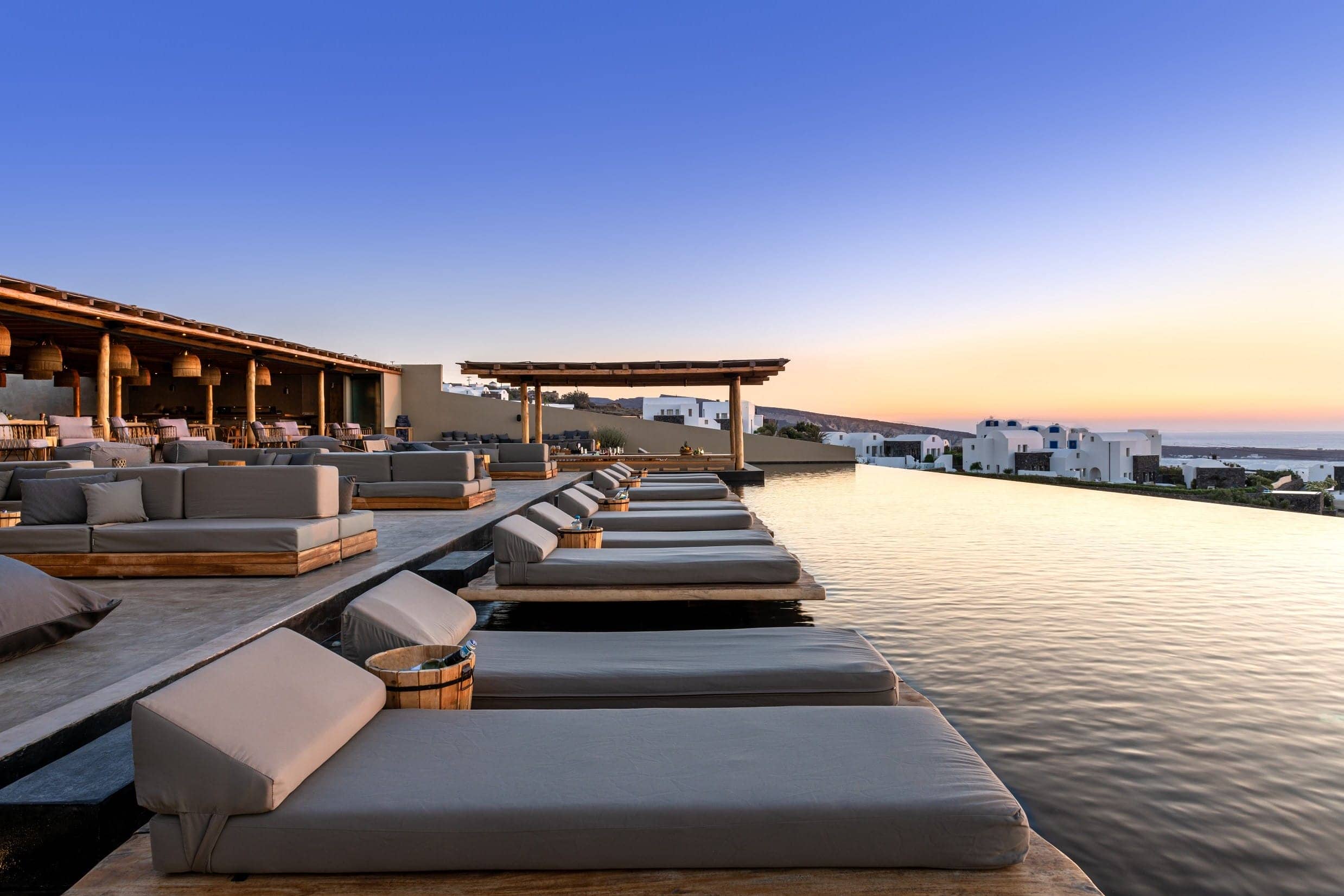
Athina Luxury Suites
Caldera-view suites in Fira with an infinity pool and fine dining.
Topics covered
Part of the Discover Cyclades editorial team, locals who ferry, hike, eat and write about these islands every season.