7-Day Sailing Itinerary: Cyclades from Lavrio
Most Cyclades sailing itineraries you find online are written by people who have looked at a chart rather than sailed one. They string together Mykonos, Paros and Santorini and call it a week. On paper that's the greatest hits. In practice it means eight hours of upwind slamming into a Force 6 to reach a marina where there's no room.
This is the route charter companies in Lavrio actually recommend to first-time Cyclades crews: a 133-nautical-mile loop through the Western Cyclades, seven legs, averaging under 20 miles a day. It works because the islands are close together, the anchorages are sheltered from the north, and you're never more than half a day from somewhere you can sit out bad weather.
Why the Western Cyclades, and why from Lavrio
Lavrio is on the southeast tip of Attica, roughly an hour from Athens airport by road and 14 nautical miles from Kea. Start from Alimos or Piraeus instead and you add about 25 miles of industrial coastline and shipping lanes before anything worth looking at. Lavrio puts you at your first island in an afternoon.
The Western Cyclades (Kea, Kythnos, Serifos, Sifnos, and Syros to the east) matter for one reason: the meltemi. This dry north wind is the single fact that governs summer sailing here. From mid-July through August it commonly builds to Force 6 or 7 by mid-afternoon and drops overnight. The western chain runs roughly north-south, which means you can plan legs with the wind behind you or on the beam rather than on the nose, and every island has a south or west-facing bay to duck into.
The eastern islands are more exposed and further apart. They're a better second charter, not a first one.
The route at a glance
| Day | Leg | Distance | Typical sailing time |
|---|---|---|---|
| 1 | Lavrio → Kea (Vourkari) | 14 nm | 3–4 h |
| 2 | Kea → Kythnos (Kolona) | 13 nm | 3 h |
| 3 | Kythnos → Serifos (Livadi) | 16 nm | 3–4 h |
| 4 | Serifos → Sifnos (Kamares) | 14 nm | 3 h |
| 5 | Sifnos → Syros (Ermoupoli) | 30 nm | 5–6 h |
| 6 | Syros → Kea | 31 nm | 5–6 h |
| 7 | Kea → Lavrio | 14 nm | 3 h |
Distances are straight-line between island centres, rounded. Real sailed distance is longer once you account for actual port positions and for tacking, so treat these as a planning floor rather than a log. Times assume 4 to 5 knots average on a 40-something-foot monohull.
Day 1: Lavrio to Kea
Boat handover is usually mid-afternoon, which suits a short first leg. Provision in Lavrio before you leave, because it's cheaper and better stocked than anything on Kea. Then head out through the Kea channel.
Anchor or moor at Vourkari, a narrow inlet on the northwest coast with good holding and shelter from the north. It is the standard first night for the whole Lavrio charter fleet, so arrive by early evening in August if you want a quay berth. The alternative is Otzias, a rounder bay a couple of miles east, quieter and better if the wind has gone light.
Kea is the closest Cyclades island to Athens and the least Cycladic-looking: greener, more terraced, with an oak forest rather than bare rock. Walk up to the Lion of Kea, a smiling lion carved into the hillside somewhere around the 6th century BC, about half an hour above Ioulida. Read the Kea island guide before you go.
Day 2: Kea to Kythnos
Thirteen miles south, and the first day where the meltemi shows itself. Leave early, by nine if you can. The wind builds through the afternoon.
The destination is Kolona, and it is the reason people sail this route. A double-sided sandbar joins the main island to the islet of Agios Loukas, so you anchor on one side and walk fifty metres to swim on the other. Shelter depends entirely on wind direction. The north side works in a southerly, the south side in the prevailing meltemi. Holding is good in sand, but it's a small bay, and by late July there will be twenty boats in it.
If Kolona is full or the wind is wrong, Loutra on the northeast coast has a small harbour and the thermal springs the island is known for. The Kythnos guide covers both.
Day 3: Kythnos to Serifos
Sixteen miles, usually a beam reach in the meltemi, and often the best sailing of the week.
Livadi on the south coast is a large, well-sheltered bay with a proper quay, fuel, and water. It's the most comfortable overnight of the trip. Above it, the Chora sits on a cone of rock with the road switchbacking up — go at sunset, eat in the square, walk down. It's a 45-minute climb on foot, or a ten-minute taxi.
Serifos is one of the islands where the site's own ranking data says people are actively looking and finding very little: see the Serifos guide for beaches and villages beyond the port.
Day 4: Serifos to Sifnos
A short 14-mile hop, and that's deliberate. Sifnos deserves an afternoon.
Kamares is the main port and the practical overnight: sheltered, with a decent quay and a long sand beach. Vathi, further south, is prettier and quieter, a near-enclosed bay with a sandy bottom and a handful of tavernas, but it offers less protection if the meltemi is really up.
Sifnos is the best place to eat in the Western Cyclades, and it isn't close. The island produced Nikolaos Tselementes, whose 1910 cookbook effectively codified modern Greek cooking, and it has a pottery tradition that still supplies the terracotta mastelo pots the local lamb is cooked in. Book a table in Artemonas or Apollonia rather than eating at the quay. The Sifnos guide has the detail.
Day 5: Sifnos to Syros
The longest leg so far at 30 miles, and the day the route turns north. Start early. In a settled meltemi this is a fast reach; in a strong one it's a long day and worth reconsidering. The fallback: run back to Kythnos and shorten Day 6 instead.
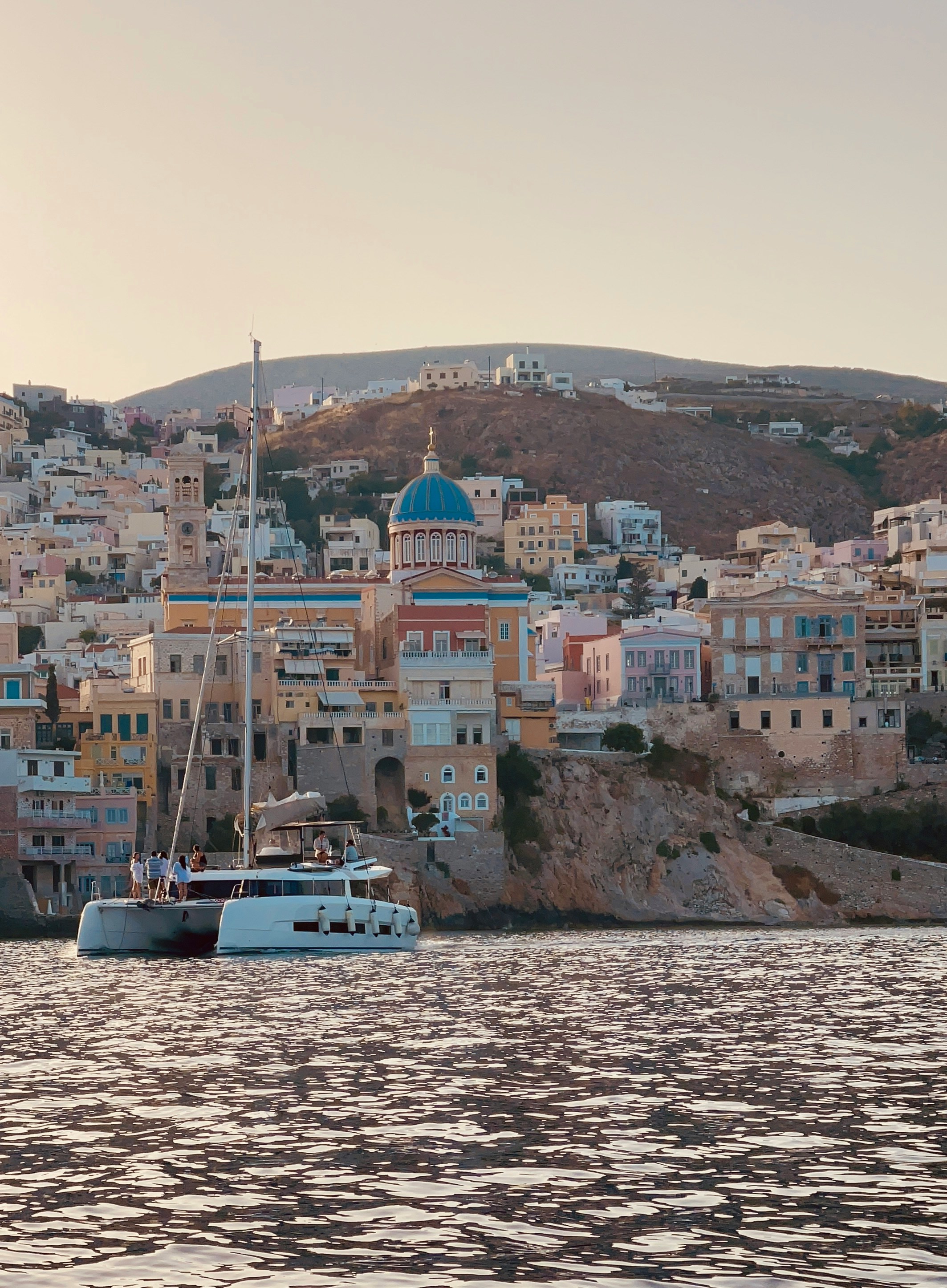
Ermoupoli on Syros is unlike anywhere else in the Cyclades. It was Greece's largest port before Piraeus overtook it, and the wealth from that period built a neoclassical town of marble squares, a working opera house modelled on La Scala, and streets of mansions that have nothing to do with whitewashed cube houses. It's also a real year-round town rather than a seasonal one, which after four days of small anchorages is a welcome change. Full berthing and provisioning available. See the Syros guide.
Day 6: Syros to Kea
Thirty-one miles northwest, the longest single leg of the week, and usually the hardest because you are working back up against the prevailing wind. This is the day the spare-time budget matters: if the forecast is bad, you'll want the option to leave a day early, or to break the leg at Kythnos.
Back at Vourkari or Otzias for a final night at anchor.
Day 7: Kea to Lavrio
Fourteen miles home. Charter companies typically want the boat back by mid-morning, so this is often sailed at first light or the evening before. Fuel up before handover — most contracts require the tank returned full.
What this costs in 2026
- Bareboat monohull, 40–45 ft: roughly €3,000–6,000 per week, depending on season and boat age, sleeping up to eight
- Skipper: €200–250 per day, plus their food
- Running costs: €700–1,200 per week for fuel, mooring, water and provisioning
- Cabin charter (a berth on a crewed boat rather than the whole yacht): from around €900 per person
Bareboat requires a recognised qualification (an RYA Day Skipper or ICC), plus a second crew member able to declare basic competence. Send certificates to the charter company well ahead of handover rather than producing them at the dock.
For day charters and crewed options based out of the islands rather than Lavrio, the Mykonos yacht rental guide covers pricing and operators on that side of the archipelago.
When to go
Late May to mid-June and September are the best windows. The wind is steady enough to sail properly, the meltemi has not established itself, anchorages have room, and charter rates sit below peak.
July and August bring the strongest and most reliable wind. Experienced crews enjoy that; inexperienced ones don't. Everything is fuller and more expensive. If this is your first Aegean charter and you're going in August, take a skipper.
April and October are viable, but the weather is less settled, some tavernas are shut, and a bad system can pin you in port for two days.
If you would rather not sail
The same islands work as a ferry-based trip, at a slower pace and a fraction of the cost. Kythnos, Serifos and Sifnos are all on the Western Cyclades ferry line from Piraeus, and Syros is a major hub. Start with the Cyclades ferry guide, or see the 7-day Cyclades itinerary for a ferry-based week covering the busier eastern islands instead.