
Sponsorizzato da Booking.com
Last updated: 27 August 2026 · Ferry weather guide
The meltemi is the dry north wind that defines Cyclades summers. It is not a Mediterranean cyclone and it is not “bad luck.” It is a seasonal pattern. From late spring into early autumn it can delay high-speed ferries, cancel small craft, and turn a well-timed island hop into a night in a port hotel.
This guide is for travellers who need a working model: what the wind is, when it peaks, how Beaufort numbers feel on a boat, which routes are exposed, and what to do when the departure board goes blank. It does not replace the operator or the port authority. Those two decide whether a ship sails. You decide how much slack you leave in the itinerary.
Before you travel: check live ferry tracking, keep the operator app installed, and prefer a conventional vessel when the forecast is already noisy. For port choice out of Athens, see Rafina vs Piraeus. For comfort on a ship that does sail, read Greek ferry seasickness.
What the meltemi actually is
The meltemi (etesian wind) is a northerly to north-easterly airflow over the Aegean, driven by the summer pressure contrast between the Balkans/Turkey high and the thermal low over the eastern Mediterranean. On the islands it feels like a hot hairdryer: dry, gusty, and often stronger in the afternoon than at dawn.
It is not the same as a winter low-pressure system with rain and long swell. Summer seas in a meltemi are typically short, steep and uncomfortable. That is why a large conventional ferry can be legally fine to sail while a catamaran is held at the quay. Passengers experience slamming, spray and a noisy cabin. Crew experience operating limits.
Local names and forecasts matter more than travel blogs. Use a marine-aware forecast (Beaufort or knots, not only “partly cloudy”), then confirm with the operator the morning of departure.
Season: late May to September, peak July–August
A practical 2026 calendar for planning — not a guarantee for any given week:
- Late May – June: the wind can appear in pulses. Many high-speeds run. Cancellations happen but are less routine than midsummer.
- July – August: peak. Several-day runs of 6–8 Beaufort are normal in the central Aegean. This is when high-speed schedules look ambitious on paper.
- September: the pattern eases, especially after mid-month, but early September can still behave like August. Do not drop your buffer the moment the calendar says autumn.
- October onwards: different weather systems take over. Meltemi talk becomes less useful; winter lows are a separate problem.
Shoulder months are still the most pleasant for hopping if you want fewer cancellations and open hotels. See Cyclades in May and Cyclades in September.
Beaufort traveller table
There is no official tourist Beaufort at which “all ferries cancel.” Use this as a personal briefing scale. Operators and port authorities apply vessel-specific limits.
| Beaufort (approx.) | What it feels like ashore | What it often means for ferries | Traveller action |
|---|---|---|---|
| 0–3 | Light air to gentle breeze | Normal operations | Travel as booked |
| 4–5 | Fresh; umbrellas struggle | High-speeds may be lively; conventional usually fine | If you get seasick, prefer a larger hull |
| 6 | Strong breeze; whitecaps | Small high-speeds start to delay or cancel; large ships often still go | Recheck the app the night before and the morning of |
| 7 | Near gale; walking is work on exposed quays | High-speed cancellations become common on open legs | Switch to conventional if a seat exists; protect flight connections |
| 8+ | Gale; spray, difficult standing | Many fast craft cancelled; some conventional routes delayed or held | Do not go to the port “just in case” without a confirmed sailing; arrange a room |
A sailing can be safe and still miserable. Cancellation is about the ship’s limits and harbour safety, not about whether you would enjoy the trip.
High-speed vs conventional in a meltemi
High-speed catamarans (the craft people book to “save four hours”) sit high, weigh less, and hit short waves hard. Outdoor decks are limited or closed. They are excellent on a calm June morning and the first to be pulled in a July northerly.
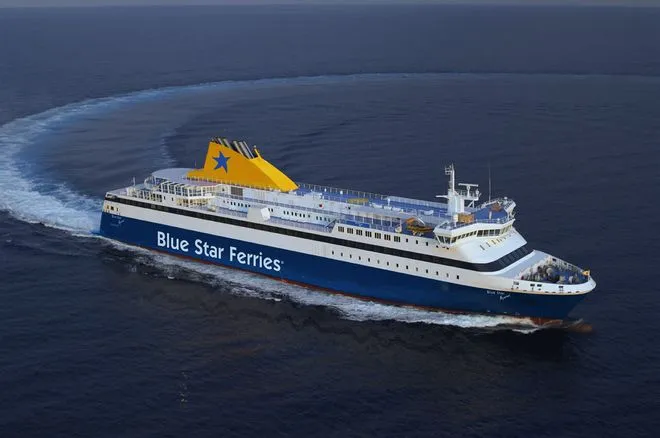
Conventional ferries (Blue Star–class ro-pax and similar) are slower, heavier, and usually more predictable in motion. They carry vehicles, have indoor space, and more often keep a published route when the catamarans stay in port. The cost is time, not automatically money — fares vary by date and class, so compare live tickets rather than a remembered number.
If you are prone to motion sickness, the hull choice matters more than the snack bar. Details: Greek ferry seasickness. If your next commitment is a flight from ATH, book the conventional option in July–August even when a high-speed is cheaper or faster on a calm day.
Exposed routes vs sheltered hops
Not every Cyclades crossing faces the same fetch.
More exposed (plan extra slack):
- Open north–south legs across the central Aegean (for example Athens–Santorini high-speeds, and some Mykonos–Santorini fast runs).
- Western high-speed chains when the northerly is funnelled between islands.
- Small-island connections on passenger-only boats (Small Cyclades, some Kimolos and Folegandros legs).
Usually more resilient:
- Large conventional ships on the main Piraeus lines.
- Short, partly sheltered hops (Paros–Naxos, Paros–Antiparos, Mykonos–Tinos on a suitable vessel).
- Morning departures, which are sometimes calmer than late-afternoon ones — a tendency, not a promise.
Rafina’s east-coast harbour is physically closer to the northern Cyclades, but a Rafina high-speed is still a high-speed. Port choice (Rafina vs Piraeus) does not cancel physics.
Delos boats from Mykonos are small and wind-sensitive. If Delos is a must-see, keep a spare morning; see Delos day trip from Mykonos.
Milos beach days also split by coast when the northerly is up — the Milos beaches guide covers the south-coast Plan B.
What to do if your boat is cancelled
Work in this order. Do not start by arguing on social media.
- Confirm it is cancelled, not delayed. Operator app, SMS, port board, and ferry tracking. Screenshots help if queues get messy.
- Go to the issuing operator first. The company that sold the ticket is the one that rebooks or refunds. A rival operator does not have to take you.
- Ask for the next available sailing on any of their vessels, including a slower conventional ship if that saves the trip. Accept a different hour or a different intermediate call if it still lands you on the right island.
- If you must change companies, buy a new ticket only after you understand whether the original is refundable. Keep receipts.
- If you are stuck overnight, book a room before you look for dinner. Port towns fill on cancellation nights. Adamas, Parikia, Naxos Town, Mykonos, and Piraeus all know this pattern.
- Tell the hotel and any transfer company. A no-show on a pre-paid transfer is a second cost.
- Do not reappear at the quay at dawn without a confirmed departure. Cancelled high-speeds sometimes stay cancelled all day.
Greek passenger rules generally require the operator to offer rebooking or a refund for a cancelled sailing. They do not require a hotel, a flight compensation chain, or a private taxi to another island. Travel insurance with trip interruption / delayed departure is the tool for knock-on flights. Read the policy before you need it.
Buffer days: the only strategy that works
A Cyclades itinerary that ends with “ferry at 07:00, flight at 13:00 from ATH” is a bet against July. Sometimes you win. When you lose, you buy a new flight.
Minimum buffers we recommend for 2026 planning:
- One full spare day between the last island ferry and an international long-haul from Athens in July–August.
- Two spare days if you are leaving from a small island with few conventional options (Folegandros, Koufonisia, Anafi, Sikinos).
- Same-day island hops are fine in the middle of a trip. Do not stack three high-speeds on the last 48 hours.
- Delos, Kleftiko, and other small-boat days belong in the first half of a stay so they can move.
Use direct route pages to see typical operators, then treat the printed duration as seasonal. The Cyclades ferry guide covers booking mechanics; this page covers the wind.
How to watch the situation like a local
- Install the operator app (Blue Star / Attica, Seajets, and whoever issued your ticket).
- Save Discover Cyclades ferry tracking.
- Check a marine forecast the evening before, not only Google’s umbrella icon.
- Ask at the hotel desk in the morning. Receptionists hear cancellations before tourists refresh the homepage.
- If you already feel unwell thinking about a 7 Beaufort high-speed, change the ticket while seats remain.
Cancellations cluster. A two-day northerly can back up whole islands. The travellers who cope are the ones who booked refundable rooms, travelled with a spare shirt in the day bag, and did not treat a high-speed as a metro.
Frequently asked questions
Will my ferry definitely sail at 5 Beaufort?
Often yes, especially a large conventional ship. You may still have a lively crossing. There is no passenger-facing guarantee tied to a single number.
Do I get a hotel if I am stranded?
Not as a standard ferry right. Operators handle the ticket. Accommodation is your problem unless a specific disruption policy says otherwise. Buy the room early.
Can I fly instead when ferries cancel?
Sometimes, on islands with airports (Santorini, Mykonos, Paros, Naxos, Milos, Syros, and a few others). Last-minute seats vanish on cancellation days. It is a backup, not a plan you invent at the quay.
Is morning always calmer?
Often, not always. A established meltemi can blow all day. Morning is a preference for boarding and for having daylight to solve problems.
Track ships on ferry tracking, compare direct Cyclades routes, and keep one spare day before you fly home.
Organizza il viaggio
Pianifica le date a Mykonos
Organizza traghetto, soggiorno e trasporti locali prima che le date più richieste si esauriscano.
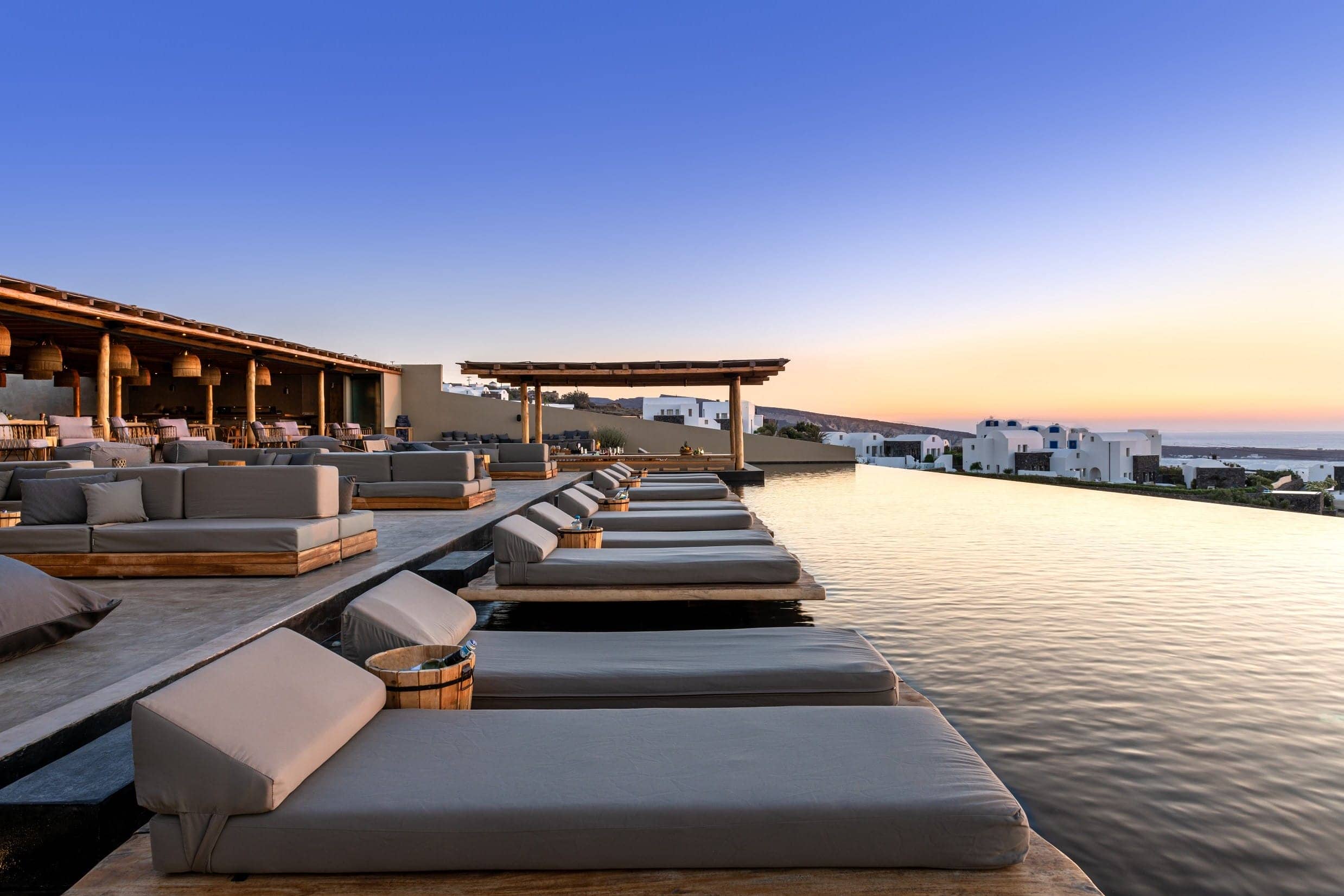
Athina Luxury Suites
Suite con vista sulla caldera a Fira, con piscina a sfioro e cucina raffinata.
Parte del team editoriale di Discover Cyclades: gente del posto che traghetta, fa escursioni, mangia e scrive su queste isole ogni stagione.


