Sponsorizzato da Booking.com
Last updated: 27 August 2026 · Ferry planning guide
Athens does not have one “Cyclades ferry terminal.” It has two passenger ports that serve different islands, sit on opposite sides of the metro area, and punish last-minute guesses. Rafina is the compact east-coast port closer to Athens International Airport (ATH). Piraeus is the country’s main passenger harbour, west of the centre, with the densest timetable for the rest of the Cyclades.
The useful question is not which port is “better.” It is which port matches your first island, your flight arrival, and your appetite for a same-day connection. Schedules, operators and vessel types change by season. Treat every duration below as a typical range and verify live sailings before you commit.
Plan the crossing, then watch the vessel. Browse direct Cyclades ferry routes, compare tickets, and keep ferry tracking open on travel day. For wind delays, read our Meltemi cancellation guide.
The 30-second answer
- Flying into ATH and sailing to Andros, Tinos or Mykonos: Rafina is usually the better port.
- First island is Santorini, Milos, Sifnos, Serifos, Ios, Folegandros, or most other Cyclades islands: Piraeus.
- Naxos or Paros: Piraeus is the default. Rafina sometimes adds seasonal high-speed calls — confirm the date, not a memory of last summer.
- Same-day airport-to-ferry with a tight connection: prefer Rafina when the island is served from there; do not gamble on Piraeus traffic after a delayed landing.
- City hotel in central Athens, no rush: Piraeus is easier by metro. Rafina needs a bus, taxi or transfer.
Where the two ports actually sit
Piraeus is the historic harbour of Athens, about 10 km southwest of Syntagma. Metro line 3 (the airport line) reaches Piraeus station, then you still walk or take a short bus/taxi to the correct gate. The port is large: gates are numbered, signs are in Greek and English, and the wrong gate can cost you the sailing even if you arrived “at Piraeus” on time.
Rafina sits on the Attica east coast, facing Evia and the northern Cyclades. It is a working fishing-and-ferry town, not a cruise complex. Check-in is simpler, walking distances are shorter, and the waterfront tavernas are part of the wait. The trade-off is frequency: Rafina does not try to be a second Piraeus. It specialises.
For a map of how islands connect once you leave Athens, use the Cyclades ferry map and the complete ferry guide.
Airport transfers from ATH
This is the decision most visitors get wrong.
ATH → Rafina is a short eastbound hop. In ordinary traffic, 20–35 minutes is a realistic window. KTEL buses run between the airport and Rafina port; taxis and pre-booked transfers are the usual backup when you have luggage or a late landing. Build extra time at peak holiday weekends and when a meltemi day has already stacked delays.
ATH → Piraeus crosses the city. Metro is predictable in duration but not always comfortable with large bags at rush hour. A taxi can be 45 minutes at quiet times and well over an hour when the Attiki Odos or the harbour approaches clog. If your flight lands after 16:00 in July or August, a same-day Piraeus sailing is a stress test, not a plan.
Practical rule: if the interval from landing to scheduled departure is under four hours, do not choose Piraeus unless you have no alternative sailing. Immigration, baggage, the metro or taxi, and port walking time all eat the clock. Rafina’s geography is the buffer.
Same-day connections still need a Plan B. See how to track Greek ferries and leave one flexible night before any international flight home.
Which islands each port serves
Rafina: northern Cyclades first
Rafina is built around the Andros – Tinos – Mykonos line. That is the reliable mental model for 2026.
- Andros: Rafina is the standard Athens port. Typical conventional crossings are often around two hours; verify the day’s vessel.
- Tinos: usually the next call on the same corridor, often in the 90-minute to two-and-a-half-hour range depending on stops and ship type.
- Mykonos: Rafina high-speeds can be among the shortest Athens–Mykonos runs in season, commonly around two hours on a fast vessel. Conventional ships take longer. Compare with Piraeus on Athens (Piraeus) to Mykonos and Rafina to Mykonos.
- Naxos and Paros: some seasons add high-speed Rafina sailings that continue past Mykonos. These are not year-round defaults. If Naxos or Paros is your first island, start from Piraeus unless you have already confirmed a Rafina departure for your date.
Andros, Tinos and Mykonos also connect to each other. A Rafina start is efficient if your itinerary stays in that northern cluster before you hop south.
Piraeus: Santorini, the west, and “the rest”
Piraeus is the port for almost everything Rafina does not specialise in:
- Santorini (Athinios): high-speed ranges are often about five hours; conventional overnight or long-day crossings run longer. Start here: Athens (Piraeus) to Santorini.
- Milos: typically a western-Cyclades routing. Fast vessels can be in the two-and-a-half-hour range; conventional ships commonly take four to seven hours. See Athens (Piraeus) to Milos.
- Sifnos and Serifos: classic Piraeus western line, often combined on the same ships.
- Ios and Folegandros: Piraeus, sometimes via other islands. Seasonal high-speeds change the pattern; conventional ships remain the weather-resilient choice.
- Paros, Naxos, Syros, Amorgos, Koufonisia, and the smaller islands: Piraeus is the default Athens gateway.
If your first night is on Santorini or Milos, stop researching Rafina. You need Piraeus.
Typical travel-time ranges (seasonal — verify)
Times below are planning ranges, not a timetable. Operators swap vessels, add or drop calls, and slow down in poor weather. Always confirm on the operator app and on live tracking.
| Route (typical) | Port | Fast vessel (planning range) | Conventional (planning range) |
|---|---|---|---|
| ATH transfer | Rafina | 20–35 min | same (road/bus) |
| ATH transfer | Piraeus | 45–90 min | metro is steadier than taxi at rush hour |
| Andros | Rafina | under 2 h on some fast runs | around 2 h |
| Tinos | Rafina | about 1.5–2.5 h | longer with extra calls |
| Mykonos | Rafina | around 2 h in season | 3 h+ |
| Mykonos | Piraeus | about 2.5–3.5 h | about 4.5–5.5 h |
| Paros / Naxos | Piraeus | about 2.5–4 h | about 4–6 h |
| Santorini | Piraeus | about 5–5.5 h | about 8–9 h, sometimes overnight |
| Milos | Piraeus | about 2.5–4 h | about 4–7 h |
| Sifnos / Serifos | Piraeus | about 2–4 h | about 3–5.5 h |
High-speed catamarans save clock time and lose comfort when the meltemi is up. Conventional ferries are slower and usually more stable. If you get seasick, read the Greek ferry seasickness guide before you pick the “fastest” row.
Who should pick Rafina
Choose Rafina when most of these are true:
- Your first island is Andros, Tinos or Mykonos.
- You land at ATH and want the shortest realistic transfer.
- You are happy with a smaller port and fewer daily options.
- You can live with a seasonal timetable that thins outside July–August.
Rafina also suits travellers who will hire a car on the island and do not need Piraeus as a logistics hub. If Mykonos is the first stop, pair the port choice with the Mykonos island guide and, if you continue to Delos, the Delos day-trip guide.
Who should pick Piraeus
Choose Piraeus when:
- The first island is Santorini, Milos, Sifnos, Serifos, Ios, Folegandros, or another island Rafina does not serve that day.
- You need frequency: more operators, more hours, more backup sailings if one is cancelled.
- You are staying in central Athens and can take the metro.
- You are carrying a vehicle, or you want a conventional overnight to save a hotel night (common on long Santorini runs).
Piraeus is also the recovery port. If a Rafina high-speed is cancelled in strong northerlies, a large conventional ship from Piraeus — when it exists for your island — is often the next useful move. That is why a mixed itinerary still benefits from knowing both harbours.
Port experience: gates, timing, and luggage
Arrive early. High-speeds can close check-in 30 minutes before departure; conventional ships are usually more forgiving but not unlimited. Peak Saturdays in July and August turn both ports into queues.
Piraeus specifics: confirm the gate on your ticket and on the operator message the morning of travel. The walk between distant gates with luggage is longer than first-timers expect. Food and ATMs exist inside the port area; do not plan a sit-down meal that ends at sailing time.
Rafina specifics: the harbour is walkable. If you arrive with time to spare, you wait on the waterfront rather than in a terminal maze. Wind is more obvious here because you are on the open east coast — a useful reminder to recheck cancellations.
Do not buy a ticket for one port and show up at the other. Tickets are port-specific. Rebooking on the day is possible when space exists, but it is not a right.
A simple decision tree for 2026
- Write down first island and ATH landing time.
- If the island is Andros, Tinos or Mykonos and you have under six hours after landing, Rafina.
- If the island is Santorini, Milos, Sifnos, Serifos, Ios or Folegandros, Piraeus — and if the landing is late, sleep in Athens and sail in the morning.
- If the island is Paros or Naxos, Piraeus unless you have a confirmed Rafina high-speed for that date.
- If the forecast is 7 Beaufort or higher, prefer a conventional hull and a buffer night. Track the ship on ferry tracking.
Island-hop after the first landing. The expensive mistake is forcing every island through the same Athens port.
Frequently asked questions
Is Rafina less crowded than Piraeus?
Usually yes at the terminal. The sailing itself can still be full in high season. Rafina’s advantage is geography and simplicity, not empty decks in August.
Can I take the metro to Rafina?
No. Rafina is not on the metro. Use the airport bus, a KTEL service, a taxi, or a booked transfer. Piraeus is the metro port.
Should I book open tickets so I can switch ports?
Book the port you will actually use. Flexibility comes from choosing operators with fair change rules and from leaving a buffer day, not from holding two contradictory tickets.
What if my flight is delayed?
Have a later sailing in mind, and a hotel near the relevant port. Same-day “we will make it” plans fail most often on the Piraeus road, not on the water.
Compare direct ferry routes, watch live ferry tracking, and read the Cyclades ferry guide before you lock the first night.
Organizza il viaggio
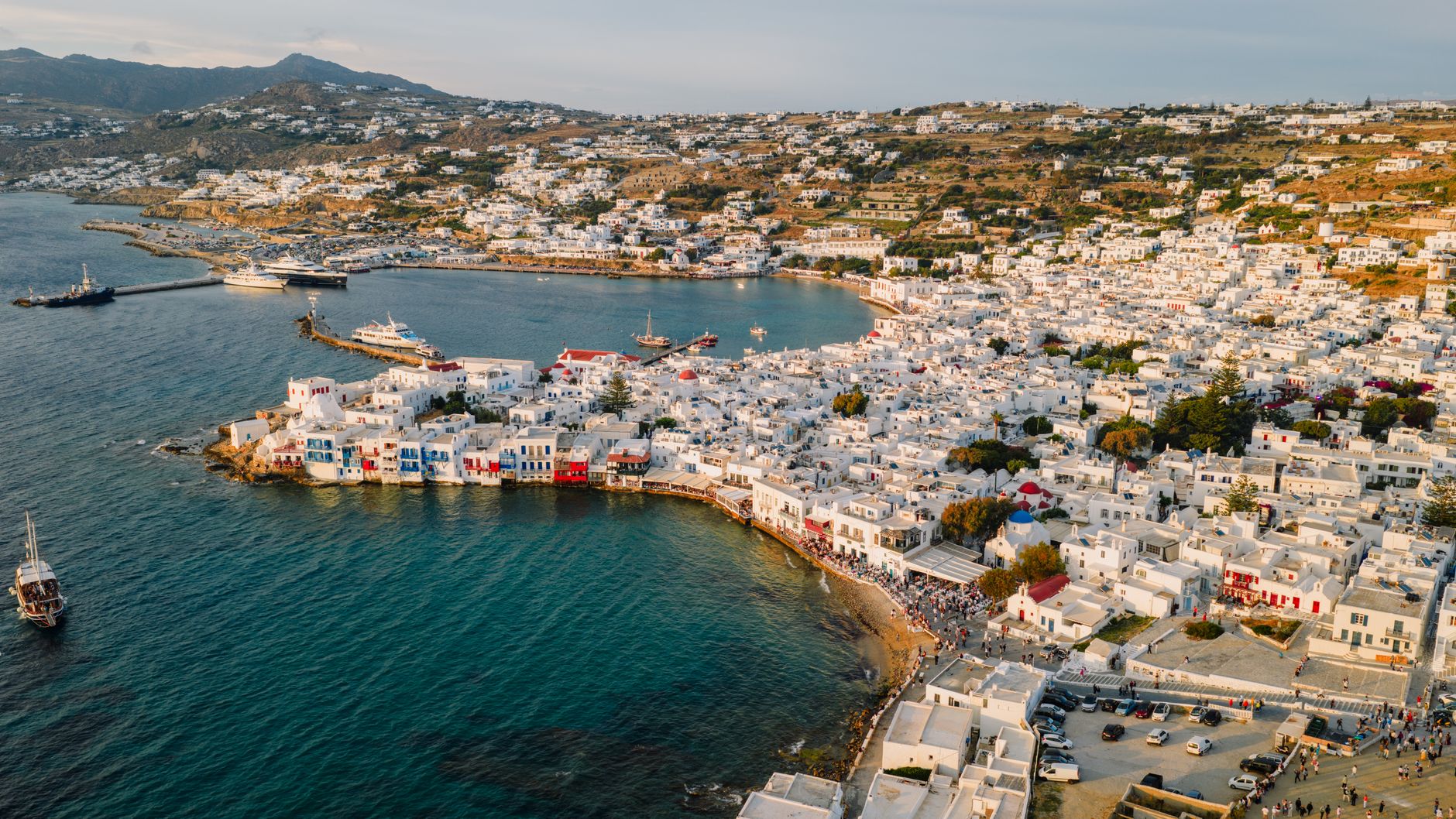
Pianifica le date a Mykonos
Organizza traghetto, soggiorno e trasporti locali prima che le date più richieste si esauriscano.

Athina Luxury Suites
Suite con vista sulla caldera a Fira, con piscina a sfioro e cucina raffinata.
Parte del team editoriale di Discover Cyclades: gente del posto che traghetta, fa escursioni, mangia e scrive su queste isole ogni stagione.